
A business owner once showed me their phone and said:
“Look — we rank #1 on Google Maps.”
A few minutes later, someone across town searched for the same service and the business was nowhere near the top of the results.
Both searches were correct.
Both results were accurate.
And both rankings were generated by the same Google system.
This is one of the most common points of confusion in local SEO. Business owners often assume that a ranking position in Google Maps is universal — that if a business ranks #1, it should appear #1 for everyone searching that service.
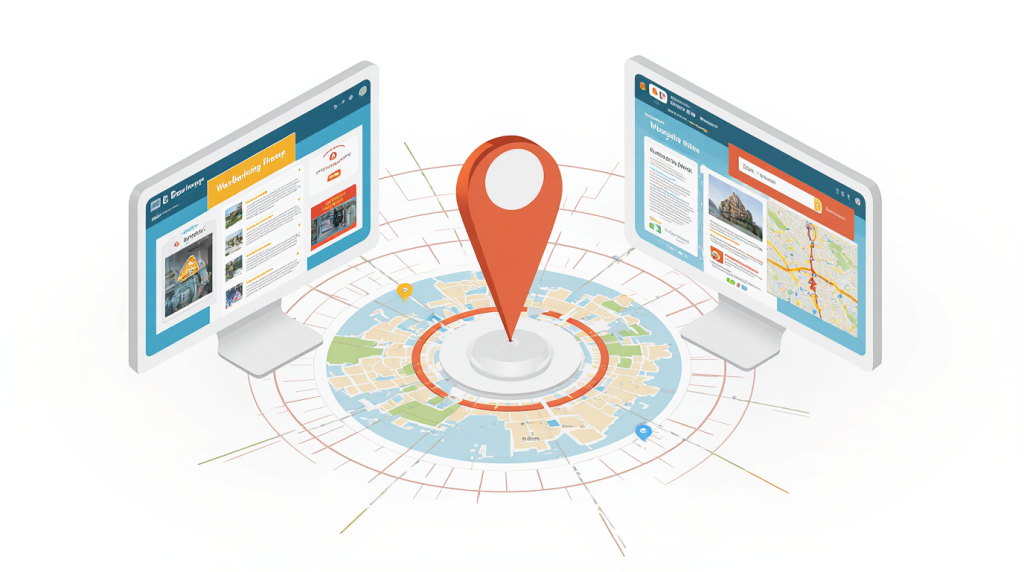
In reality, Google Maps rankings change depending on where the search is performed.
Understanding why this happens is an important step toward accurately interpreting local SEO results.
To see why rankings change, it helps to first understand how business owners usually evaluate their own visibility.
Local service businesses frequently evaluate their visibility by performing a quick search on their own phone or computer.
If they see their business near the top of Google Maps, they assume their visibility is strong.
If they see the ranking drop on another device or from another area, it may feel like something has gone wrong with the SEO campaign.
Neither interpretation fully reflects how local search actually works.
Google does not generate one universal ranking list for every user. Instead, it adjusts results dynamically based on the searcher’s location and the type of service they are looking for.
This behavior is not a bug or an inconsistency.
It is a core part of how local search functions.
Google’s local search system prioritizes businesses that are geographically relevant to the person performing the search.
If two people search for the same service from different parts of a city, Google will often show different businesses near the top of the results.
This happens because proximity plays a significant role in local visibility.
For many service searches, Google attempts to balance three core signals:
A business may have strong authority and a well-optimized profile, but if the search is performed several miles away, Google may prioritize businesses that are physically closer to the searcher.
This is why a company may appear highly visible in one part of a city while appearing lower in the results somewhere else.
If you want a deeper explanation of how these signals interact, see our guide on how Google Maps Rankings Actually Work.
From a business owner’s perspective, ranking differences can feel unpredictable.
One search shows strong visibility.
Another search shows something completely different.
But the change is usually not random.
It is the result of Google adjusting results to match the searcher’s location and the likely intent behind that search.
Local search is designed to help users find nearby solutions quickly. If someone searches for a service while standing in a specific neighborhood, Google assumes they want businesses that are accessible from that location.
Because of this, Google Maps rankings should be understood as dynamic visibility zones rather than fixed ranking positions.
If rankings change depending on where the search is performed, then a single search result cannot fully represent a business’s local visibility.
This is one reason many small businesses misinterpret their SEO progress.
A search performed from inside the office may not reflect how potential customers see results across the broader service area.
Evaluating local SEO properly requires looking at patterns across locations rather than relying on a single search.
If this idea feels familiar, it connects closely to another common misunderstanding we explored in Why Small Businesses Misread Local SEO Progress.
Understanding how search visibility behaves across different areas helps business owners interpret what they are seeing in Google Maps more accurately.
Instead of viewing Google Maps rankings as a single position, it is more helpful to think of local visibility as a coverage area.
Some businesses have strong visibility close to their location but gradually lose visibility farther away.
Others may appear consistently across a wider service area because they have built stronger authority signals.
Both scenarios are normal outcomes within Google’s local search system.
What matters is not whether a business ranks #1 everywhere, but whether the business appears where customers are most likely to search.
Many businesses try to track local rankings as if they were a single position across an entire city.
But Google Maps does not evaluate visibility that way.
Instead, local visibility tends to behave more like a coverage zone that expands outward from the business location.
Near the business address, visibility is often strongest because proximity heavily favors nearby results.
As distance increases, Google relies more heavily on signals like relevance and prominence to decide whether the business should still appear in results.
Because of this, many service businesses experience a pattern where visibility is strongest close to their location and gradually becomes less consistent farther away.
Understanding local rankings as coverage zones rather than fixed positions helps explain why rankings change from neighborhood to neighborhood.
When a ranking changes from one location to another, it does not necessarily mean that something has gone wrong.
Often, it simply reflects how Google balances proximity with relevance and authority when deciding which businesses to display.
Understanding this behavior helps service businesses interpret local search results with greater clarity.
It also prevents unnecessary concern when rankings appear to shift across neighborhoods or devices.
Local visibility is rarely a single fixed position.
It is a system that adapts based on where the search begins.
Many misunderstandings about local SEO come from assuming that rankings behave the same way they do in traditional search results.
Local search works differently.
Once you understand how proximity influences Google Maps visibility, many of the ranking changes that seem confusing at first begin to make sense.
For service businesses trying to understand the broader structure behind local visibility, the full system — including how proximity, relevance, and authority interact — is explained in the Get Found Method Playbook.
If you’re exploring how local visibility behaves in Google Maps, these articles expand on related concepts.