
One of the most common questions service business owners ask when building or updating a website is:
“What pages should I have?”
At first, the answer seems simple. Most people assume every website needs a homepage, an about page, a service page, and a contact page. Others start searching online and find lists recommending ten, fifteen, or even twenty different pages.
The challenge is that there is no single list that works for every business. A plumbing company, a photographer, an electrician, and a cleaning service may all need different website structures because they offer different services and serve customers in different ways.
The better question is not simply how many pages a website should have. It’s whether the pages help customers understand what the business does and how to take the next step.
Every page on a website serves a purpose. Some pages explain services. Some build trust. Some answer questions. Others help customers contact the business or request an estimate.
When customers visit a website, they are usually trying to answer a few simple questions:
The pages on a website should help answer those questions clearly.
This is one reason many service businesses struggle online. They often focus on creating more pages because they think that doing so automatically leads to better results. In reality, pages are most effective when they help customers find the information they need quickly.
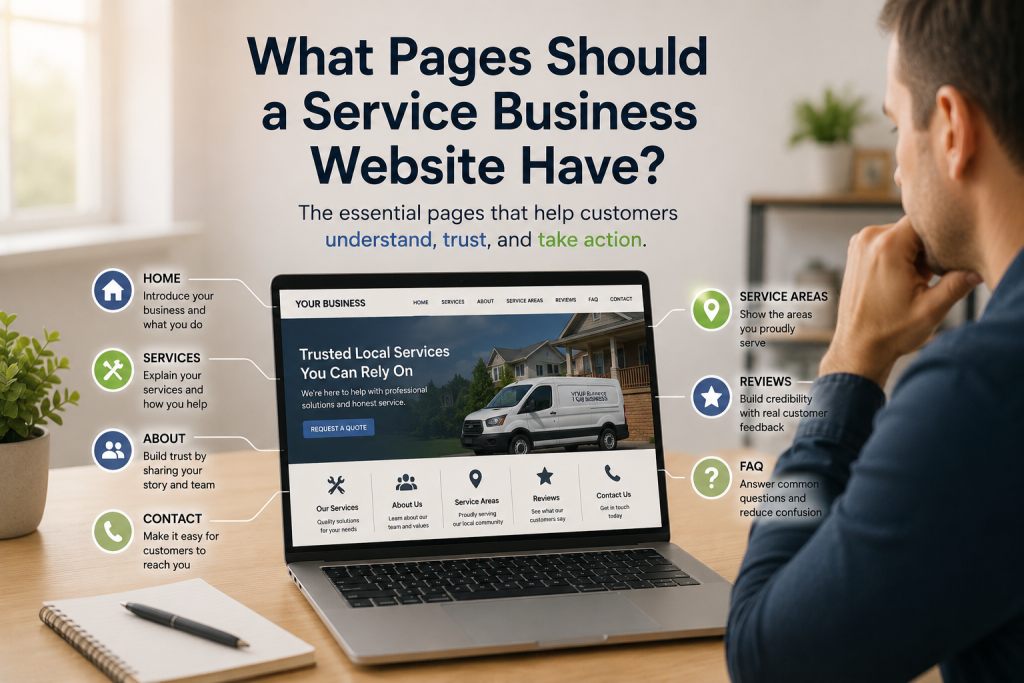
While every business is different, most service business websites benefit from having a few foundational pages.
A homepage serves as the starting point. It should clearly explain what the business does, who it serves, and what action visitors should take next.
A services page helps customers understand the solutions the business offers. Depending on the company, services may be grouped together or separated into individual pages.
An about page helps establish trust by explaining who the company is, how it operates, and what makes it different.
A contact page provides customers with a clear way to reach the business by phone, email, form, or other contact methods.
Many businesses also benefit from having pages that answer common customer questions, explain service areas, or provide additional information to support the customer decision-making process.
The exact mix depends on the business itself.
Not necessarily. One of the most common mistakes business owners make is assuming every service should automatically have its own page.
Sometimes that makes sense. Sometimes it doesn’t.
For example, a company that offers several distinct services may benefit from giving each service its own dedicated page. This can help customers find exactly what they need and better understand the differences between services.
In other cases, multiple services naturally belong together because customers think of them as part of the same solution.
The decision is less about creating the maximum number of pages and more about creating pages that make sense to customers.
If a website becomes difficult to understand, adding more pages usually makes the problem worse rather than better.
For businesses that serve specific cities or regions, location pages can sometimes play an important role. However, not every business needs a separate page for every town it serves.
The decision often depends on the company’s service area, business goals, and how customers search for those services.
This is why location pages should be created intentionally rather than simply copied across dozens of cities.
A smaller number of useful pages is often more valuable than a large number of nearly identical pages.
Many business owners believe website growth means constantly adding new pages.
That isn’t always true.
A website with twenty pages that clearly explains the business will often outperform a website with fifty pages that creates confusion. Customers do not judge a website by page count. They judge it by clarity.
If potential customers can find your website, quickly understand what the business does, trust the company, and know how to take the next step, the website is doing its job.
Adding pages is only valuable when they improve the customer experience or provide information customers genuinely need.
There is no perfect number of pages every service business should have.
The right website structure depends on the business, its services, its customers, and its goals.
Most businesses need a homepage, service information, company information, and a clear way for customers to get in touch. Beyond that, the focus should be on clarity rather than page count.
The goal is not to create the largest website possible.
The goal is to create a website that helps customers understand the business and confidently take the next step.