
Choosing an SEO company can be difficult for a simple reason: you are often being asked to evaluate work you may not fully understand yet. One company may recommend rebuilding parts of your website. Another may focus on Google Business Profile optimization. Someone else may talk about backlinks, content, citations, technical SEO, or monthly deliverables, and each of those recommendations can sound reasonable in isolation. The harder question is whether it is the right recommendation for your business right now, which is the real work of choosing an SEO company well.
You do not need to become an SEO expert before hiring help. You do need enough understanding to recognize whether a company is diagnosing your business before prescribing work, whether its recommendations have a clear purpose, and whether you understand what your investment is meant to accomplish.

Part of that starts before you ever compare proposals: knowing what problem you are actually trying to solve, rather than shopping for a package. Why Hiring a Marketing Agency Feels Confusing covers that groundwork in more depth. Here, we’re picking up from that point and looking specifically at how to judge the thinking behind a company once you’re evaluating one.
One of the most revealing parts of choosing an SEO company happens before the proposal ever reaches you. What does the company actually try to understand about your business first?
Local SEO does not exist separately from the business it supports. Your services, revenue priorities, service areas, current visibility, competition, and customer search behavior all shape what should happen next, which means a sound recommendation should come after some real diagnosis rather than before it. If every business receives essentially the same starting plan — more content, more backlinks, more citations, more optimization — that plan may be built around the company’s delivery model rather than your actual situation. Standardized process isn’t inherently a problem; SEO companies need repeatable systems to operate. The distinction worth watching for is whether that process still leaves room for your business reality to shape the strategy, or whether it runs the same way regardless of what it finds.
SEO can be hard to evaluate because almost any individual tactic sounds legitimate on its own. Backlinks, content, Google Business Profile work, website changes, and keyword research can all matter — the real question isn’t whether a tactic counts as good SEO in general, but why it matters for your business at this particular stage.
That distinction matters because local SEO functions as a connected system, where work in one area often depends on clarity somewhere else. Creating more content won’t fix a website structure problem, and building links to pages that poorly represent your services doesn’t correct the underlying mismatch. Even increasing visibility for the wrong search terms can generate more activity without producing better business opportunities. When a company recommends something, you should be able to follow the reasoning behind it in plain language, even if you couldn’t execute the work yourself.
SEO proposals often list a lot of activity: monthly content, technical audits, backlink building, citation work, reporting, profile management, on-page optimization. The presence of all that work doesn’t tell you whether the underlying strategy is strong. A real strategy requires prioritization — deciding which of ten possible improvements matter first, which can wait, and which depend on something else being corrected beforehand.
This is also how to think about the proposal itself. A proposal should do more than show you how much work will be performed each month. It should give you enough context to understand what the work is intended to improve and why those priorities make sense for your business. A longer list of deliverables is not automatically a stronger strategy.
This is where a company’s thinking becomes much easier to evaluate. A company with a sound understanding of SEO priorities should be able to tell the difference between what matters eventually and what matters now, and should be willing to hold some work back until the groundwork supports it. This is the same principle behind the GFM Local SEO Order of Operations: sequence matters because not every legitimate SEO activity is the right next activity. That restraint is a good sign, not a lack of ambition. A long list of deliverables can make a proposal look substantial, but the goal was never to keep a vendor busy — it was to improve the visibility system supporting your business.
SEO can technically succeed while still producing the wrong result for your business. A company might increase rankings or traffic for searches that don’t represent your most valuable services, expand visibility into areas you don’t realistically serve, or chase broad keywords because the search volume looks impressive even when those searches aren’t a good match for the customers you actually want.
This is why business alignment matters as much as technical skill. The company brings search expertise; you bring something it can’t replace: knowledge of your own business—which services are profitable, which customers are the right fit, where you actually want to work, and how you want the business positioned. Strong SEO decisions need both. The goal isn’t for the agency to make every call while you wait for a report; it’s a relationship where technical expertise and business knowledge work toward the same goal.
It’s reasonable to want a clear sense of what you’ll get for your investment. But SEO involves variables no company fully controls — competition shifts, search behavior changes, Google updates its systems, and some improvements simply take time before their effect becomes visible. Because of that, there’s an important difference between a company offering a reasonable expectation and a company guaranteeing a specific outcome.
A trustworthy company should be able to explain what it intends to improve, what signals it will be watching, and roughly what a realistic timeframe looks like, while being far more cautious about promising a specific ranking by a specific date. If timelines are part of what you’re weighing, Why Local SEO Takes So Long to Work explains why meaningful progress tends to build gradually rather than arrive all at once. A company can be confident in its approach while still being realistic about what it cannot guarantee.
Reporting should help you understand whether the work is actually moving your business in the direction you hired the company for. SEO does involve real data, and that data can get technical — the important thing is that it connects back to the objective rather than standing on its own. If rankings improved, it’s worth knowing which searches moved. If traffic increased, it’s worth knowing where it came from. If visibility expanded, it’s worth knowing whether that expansion touches the services and locations that actually matter to your business.
A report full of encouraging numbers can still leave the most important question unanswered: are you making meaningful progress toward the problem you hired this company to solve? The purpose of reporting is understanding, not just proof that work happened.
A knowledgeable SEO professional will naturally understand things you don’t, and that’s part of why you’re hiring one. The problem is when that expertise makes it harder for you to understand the reasoning behind the work. You should be able to ask why something is being recommended without needing a technical education first in order to follow the answer. Good communication doesn’t mean stripping out every technical term — it means the reasoning behind the work gets translated into language that actually connects to your business.
If you keep leaving conversations knowing what the company plans to do but still can’t explain why, that’s worth paying attention to. Understanding doesn’t require you to control every implementation decision. It just means staying involved in the direction, rather than handing that over along with the execution.
There’s no single SEO company that’s automatically right for every service business. A small local contractor may need something very different from a multi-location company, and a business with a strong website but weak local visibility needs different support than one whose website structure is fundamentally unclear. Budget and internal capacity matter too — some owners want a company to execute nearly everything, others want strategic guidance while an internal team handles implementation, and some businesses need focused help with one part of the visibility system rather than a broad monthly engagement. “Best SEO company” is ultimately a business-specific question, not a universal ranking. The better fit is the company whose capabilities match the problem you actually need solved, whose recommendations you can follow, and whose approach respects your business priorities.
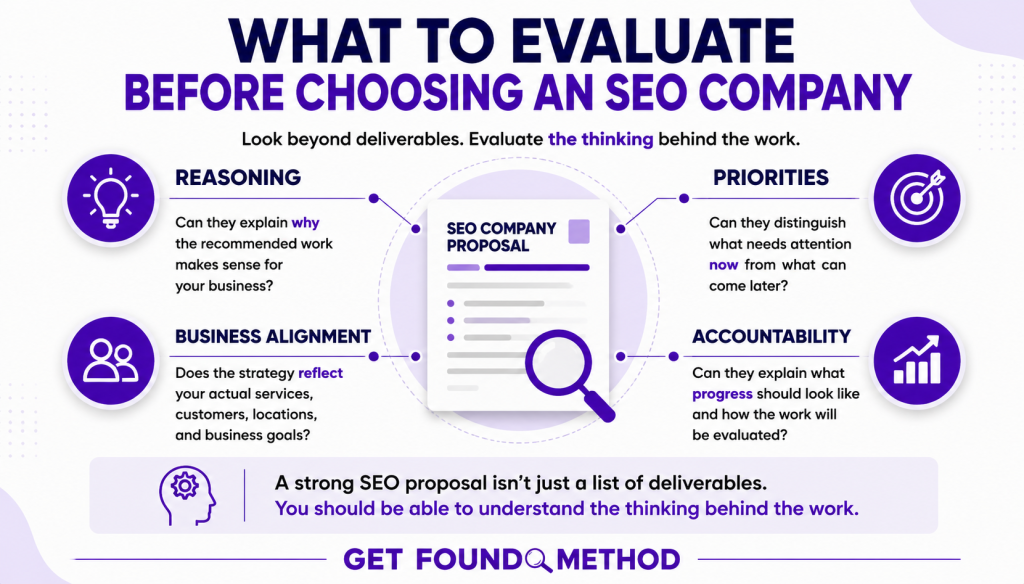
Hiring an SEO company doesn’t mean giving up ownership of your SEO decisions. It means deciding where outside expertise can help you execute more effectively. You don’t need to understand every technical detail before hiring someone, but you do need enough clarity about the direction — what problem is being addressed, why certain work comes first, what progress should look like, and how the strategy supports the business you’re actually trying to grow — to stay an informed partner in the work rather than a bystander to it.
If you’re considering hiring an SEO company but still feel unsure how local SEO fits together as a whole, the Local SEO Playbook builds that foundation. It walks through how local visibility works, why sequence matters, and how to recognize what should happen before you invest in execution — not to turn you into an SEO professional, but to help you make intentional decisions whether you handle the work yourself or bring someone in to help.