
If you’re trying to improve your local SEO, finding a checklist is easy. The harder part is knowing what to do with it.
One checklist may tell you to optimize your Google Business Profile. Another may tell you to build citations, collect reviews, research keywords, improve your website, create content, earn links, and track rankings. Those may all be legitimate parts of local SEO, but seeing them on the same list doesn’t mean they should receive the same attention at the same time.
For a service business, a useful local SEO checklist should help you understand both what needs attention and roughly what order to approach it in. The areas below are arranged to reflect the general progression of the work. They aren’t seven isolated projects, and working through them isn’t a substitute for evaluating your business’s specifics.
Before deciding on pages, keywords, or profiles, it helps to recognize that customers don’t all search for local businesses the same way. Someone dealing with an urgent plumbing problem may search differently than someone planning a bathroom renovation, and customers may encounter a business through Google Maps, a website, or other search tools.
At this point, you don’t need to map every possible way customers search. You just need a basic understanding of how people look for the services you provide before deciding on the rest of your local SEO.
Once you have a general sense of how customers search, the next question is what you actually want to be found for.
A plumber who offers emergency repairs, water heater service, drain cleaning, and general plumbing work doesn’t just need to “rank for plumbing” — those are distinct services that customers may search for differently. Why Many Local SEO Campaigns Fail looks at what happens when this step gets skipped and everything downstream gets built on assumptions instead.
With a clearer sense of your services and how people search, the website needs a structure that can actually represent them — before keyword work or content begins.
Structure matters here because it’s what search terms eventually get matched to. If a page is trying to represent three different services at once, adding keywords to it doesn’t fix the underlying mismatch. How to Structure a Website for Local SEO goes deeper into how to think through this.
Once the site has somewhere for keyword work to live, you can start connecting your services to the language customers actually use.
A term can look appealing simply because many people search for it, without being a good fit for your business. The service, the location, and the customer behind the search all need to line up.
Your Google Business Profile is often the most visible part of your local search presence, and it works best when it’s consistent with everything else — your website, your service information, and how your business is represented elsewhere online.
This is also a reasonable point to check that other places your business appears — directories, citations, other listings — aren’t quietly contradicting what your website and profile say. You don’t need every reference to be perfect; you need the important ones to agree with each other.
Being visible gives a potential customer an opportunity to discover your business, but choosing it usually requires enough trust to continue.
A potential customer often moves through several things before contacting a business — seeing it in search, reading a few reviews, glancing at the website, comparing options — and trust builds across that whole path, not from any single element. Do Google Reviews Help SEO? looks at the role reviews actually play in that.
Once the earlier pieces are in place, measurement starts to mean something.
Rankings and traffic can help you evaluate progress, while the business outcome remains whether the right customers are finding you, understanding what you offer, and making contact. Why Local SEO Takes So Long to Work explains why that usually takes longer than most people expect.
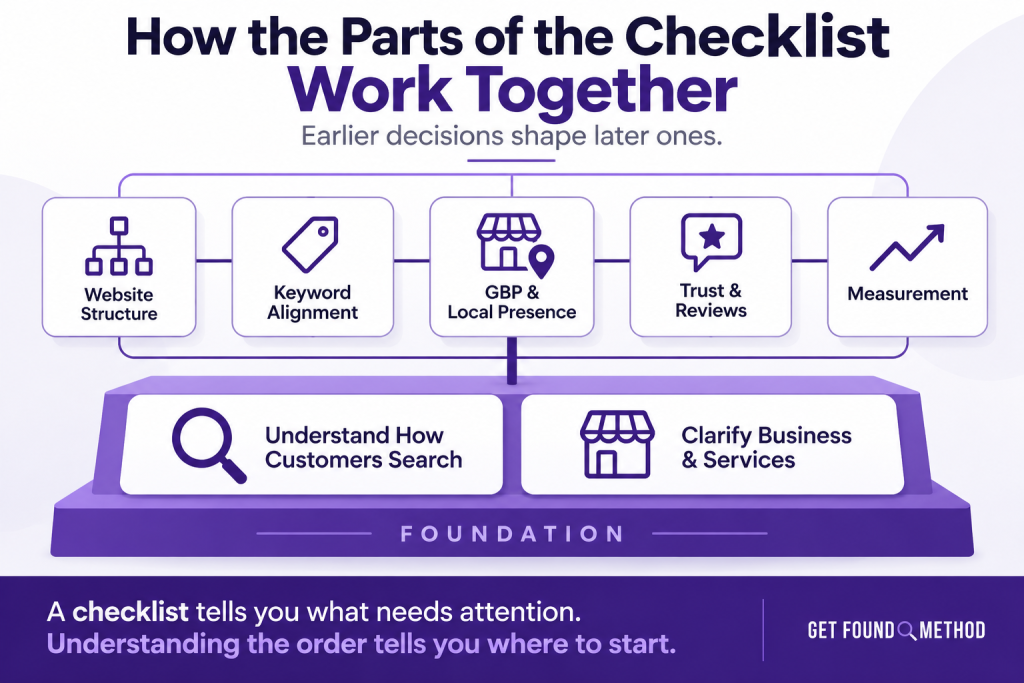
Although these seven areas are separated for clarity, they work as connected parts of the same local search foundation.
Understanding how customers search gives the next decisions something real to be based on. That understanding, combined with clarity about your services, shapes what the website needs to communicate — which is what keyword work eventually gets matched to. Your Google Business Profile and other local information then need to agree with what the website already says, while reviews and trust signals strengthen what customers encounter along the way. Measurement, at the end, is what tells you whether all of that is actually working together.
None of this requires finishing one area completely before starting the next — local SEO rarely moves that cleanly in practice. The practical point is that earlier decisions shape later ones. Once those relationships are visible, the checklist stops being a pile of unrelated tasks and starts working like an actual sequence.
Start by getting honest about the foundation: do you have a basic sense of how customers search, and can you clearly say what services and areas you’re trying to be found for? If either of those feels shaky, that’s the real starting point — not the website, not the profile, not reviews.
From there, each piece gives the next one more to work with. A clearer sense of search behavior and business priorities gives the website something specific to represent. A well-structured website gives keyword work somewhere to land. A website and profile that agree with each other give reviews and trust signals something solid to reinforce. And a business that’s already doing those things consistently is the one where measurement actually tells you something useful.
You may find that some of these areas are already in good shape — that’s useful to know too. The point isn’t to restart everything because one item happens to be listed early. It’s to notice where the sequence currently breaks down, so your next move has a reason behind it.
A local SEO checklist can tell you what deserves attention. Its real value is in showing how those areas relate to each other. Before adding another tactic, look at what’s already established, what the next piece depends on, and whether the work actually supports the customers your business wants — that’s what keeps the checklist useful, instead of letting the checklist make the decisions for you.
This checklist tells you what to look at and roughly in what order. The Local SEO Playbook goes further — it walks through the full decision sequence, helps you diagnose where your business currently stands in it, and gives you a framework for deciding what to prioritize next.