
If you’re looking for a local SEO strategy, you have probably already come across some of the activities involved. Google Business Profile, reviews, service pages, and keyword research may have come up, and some of it may already be underway. What often remains unclear is how those pieces are supposed to fit together, and which ones deserve attention before the others.
A local SEO strategy answers those questions. It is a set of decisions about what the business needs its online presence to produce, which services deserve the most effort, how the different activities depend on one another, and what should come first. The rest of this article explains each of those considerations and how they connect.

Search for local SEO strategy and many of the results describe a single activity: keyword research, review generation, or Google Business Profile optimization, each presented as the strategy. Each of those has a legitimate place. None of them, taken alone, tells you why you are doing it, how it connects to the rest, or what to do when you can’t do everything at once.
That gap separates a collection of tactics from a strategy. A tactic is a single action, while a strategy is the reasoning that determines which actions the business takes, in what order, and for what purpose. Two businesses can carry out the same tasks and have very different strategies, because the decisions behind those tasks differ.
A strategy begins with the business, and specifically with what it needs its online presence to accomplish. Many local SEO efforts begin with an activity instead. An owner hears that reviews are important, that the profile should be complete, and that the website needs more content, and each piece of advice becomes a task without anyone asking what the tasks are collectively supposed to produce.
For a service business, the answer lives in revenue. Some services bring in most of the income, some bring the customers the owner most enjoys working with, some fill slow periods, and some are offered mainly because customers ask for them. Where the business’s income actually comes from, and where the owner wants it to come from over the next few years, determines which visibility is worth pursuing. This is why GFM puts service-revenue alignment ahead of keyword selection: a search term can attract plenty of people and still lead to jobs the business would prefer not to do more of.
These decisions belong to the owner, since they involve the owner’s capacity, preferences, and plans. Marketing advice can inform them, but it cannot settle them on the owner’s behalf.
Once the business’s goals are clear, service priorities become clear. A company may offer six services, but those services are unlikely to contribute equally to its revenue or future plans. Giving each one the same attention treats them as equally important, which may not reflect where the business is trying to grow.
Service priorities give effort a direction. A business that has decided which services it most wants to be known for can judge every other decision against that choice: which pages deserve the most care, which services to emphasize in a Google Business Profile, which reviews are most useful to encourage. Without that choice, each of those decisions gets made independently, and the results tend to reflect whatever was easiest or most recently recommended.
Setting priorities also means accepting that some services will receive less visible attention. That can feel uncomfortable, particularly for services customers do request, and it is a reasonable trade when the choice is deliberate. How to weigh services against one another depends on a business’s own numbers and circumstances, which is why it cannot be reduced to a rule that applies to every company.
Goals and service priorities tell you where effort should go. The relationships between the activities themselves affect how well that effort works, and they are the part of strategy most often missing from lists of tactics.
Getting more people to find your business online only helps so much if they can’t find the information they need once they reach you. A customer looking for a local service business might see the business in a map result, open its Google Business Profile, and then visit the website to find out whether the company handles the specific job they need. The profile is how that customer first learns the business exists, and the website has to help them decide whether it is the right one. If the site has no page that speaks directly to the service they came for, they arrive with nowhere to confirm what they hoped to find.
Improving the profile still has value because it helps more people discover the business, but that additional attention may not lead to inquiries if the website cannot answer their questions. Neither activity has to be finished before the other begins, because they support different stages of the same customer’s experience and are better planned together. This is a dependency: the profile can help people find the business, but the website influences whether they have enough information to take the next step.
The same is true of decisions about services, search terms, and website pages. Choosing which search terms to pursue depends on knowing which services the business wants to grow, because otherwise the terms are chosen without a reason to prefer one over another. Those service decisions also shape the pages the website needs, since a site’s structure should reflect the services the business actually provides and how those services relate to one another. Search terms can then be aligned with the pages that represent those services. A business that chooses search terms before deciding which services to grow can end up with terms, and later pages, that don’t match where it wants to go, and then has to revisit those choices.
Not every pair of activities is tied together this closely. Requesting reviews after completed jobs, for example, can generally continue while the website is being improved. Some SEO tasks need to happen in a certain order, while others can move forward at the same time. A strategy helps the owner recognize the difference. Working out which tasks fall into which group for a particular business depends on that business’s starting point, and a general article cannot do that evaluation for you.
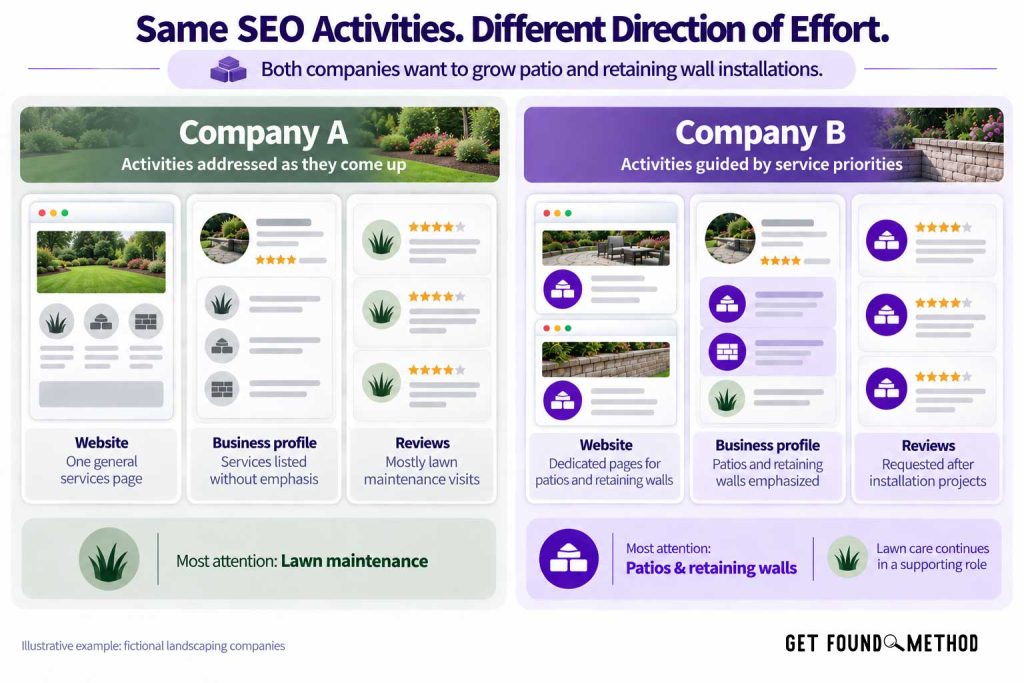
Consider two landscaping companies in the same metro area. Each earns most of its revenue from patio and retaining wall installations, which are larger projects that the owners want more of. Lawn maintenance is a smaller share of income, though it keeps crews busy between installations. Both owners have about the same amount of time each week to put toward local visibility, and both spend it on the same things: their Google Business Profile, their reviews, their website, and some written content.
The first company approaches each task as it comes up. Lawn care is the easiest service to write about, so most of the articles cover seasonal lawn topics. Review requests go out after every job, and because lawn visits far outnumber installations, most of the reviews describe maintenance visits. The profile lists services in the order the owner happened to enter them. The website has a single services page covering everything the company does, because that page was there from the start. Each choice is reasonable on its own, and each is a task commonly recommended.
The second company begins by deciding that patios and retaining walls are where it wants to grow. It builds dedicated pages for those services first, since the website is where a visitor decides whether the company can handle the project. It emphasizes the same services in its profile so the two point in the same direction. It asks for reviews after installation projects in particular, because those reviews speak to the projects it most wants more of. Lawn care stays on the website and in the profile in a supporting role.
The first company’s efforts have given lawn maintenance more attention and supporting content, even though the owner wants to grow installation projects. The second company’s website, profile, and reviews are working toward the same service priorities. Both owners invested similar time and performed similar activities, but the decisions behind those activities gave their efforts different directions.
Once goals, priorities, and dependencies are understood, the remaining decision is sequence: which tasks come first, which run alongside them, and which wait. Having an order changes how a business spends its effort.
Owners who try to advance every area at once often advance none of them far enough to see results, and a sequence lets attention concentrate where the dependencies say it will pay off first. Postponement also becomes deliberate: anything placed later in the sequence has been considered and put there for a reason, so leaving it for now does not leave the owner wondering what has been missed. The strategy can be revisited when the business changes, since a new service, a new service area, or a shift in what the owner wants from the business alters the goals the rest of the plan was built on. GFM’s name for this discipline is the Order of Operations, the framework that governs how local visibility efforts are sequenced.
A clear sequence also helps when the owner brings in outside help. An owner who knows what the business needs, which services come first, and why can evaluate what an agency or freelancer proposes against a plan of their own, and can decide which tasks to handle personally and which to hand off. The decisions stay with the owner.
The two landscaping companies spent similar time on similar tasks. What set them apart was whether their SEO activities supported what each business was trying to achieve. A local SEO strategy is what builds that support: it links what the owner wants the business to accomplish with the services that need to grow, the tasks that support those services, how those tasks depend on one another, and the order in which they should happen. With those links in place, a new task can be weighed against the direction the business has chosen, and a suggestion to add something can be judged on the same terms.
Because the links are built from the business’s own circumstances, the resulting strategies vary. Two service businesses can share a trade and a city and still arrive at different priorities, since their revenue sources, markets, goals, and starting points are not the same. A coherent strategy is one whose parts fit together for the business it belongs to.
This article explains what goes into a local SEO strategy and how the parts relate to one another. Turning that understanding into decisions for your own business is a separate task, because it requires looking at your services, website, profile, and market as they stand today. The Local SEO Playbook is built for that step. It teaches the Order of Operations and the reasoning behind it, so you can evaluate where your business stands, understand what should come first, and make the prioritization decisions for yourself.
Explore the Local SEO Playbook