
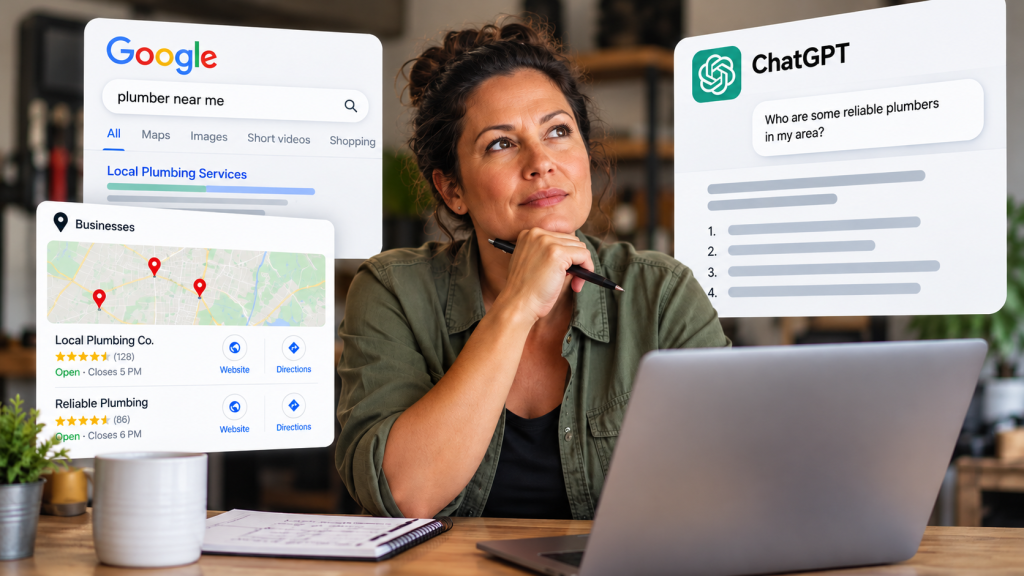
AI search has introduced a new set of terms into conversations about getting found online. Business owners are now hearing about AI search optimization, Generative Engine Optimization, Answer Engine Optimization, and other approaches that can sound like an entirely new branch of marketing.
That raises a reasonable question for a service business that has already invested time or money in SEO: Does AI search require a different strategy, or does it build on the SEO practices you already use?
The answer starts with understanding what AI search optimization actually means, how the term is used, and what we currently know about its relationship to established search practices.
AI search optimization is a broad term for efforts to improve how a business and its information are found and presented in AI-powered search tools.
Traditional search usually gives someone a list of results to explore. AI-powered search can pull information from several sources and combine it into a written answer to the person’s question. Depending on the platform and the question, a business might be mentioned, cited, or linked within that answer.
That gives customers another way to find businesses, and each platform decides for itself how information appears in its answers.
The phrase AI search optimization can make this area sound more standardized than it is. In practice, it serves as an umbrella term for a part of search that is still changing, with no single agreed-upon set of practices that applies across every AI search tool.
If you’re deciding whether a new AI search service or tactic deserves your time or budget, that context should come first.
Two terms you are likely to encounter are Generative Engine Optimization (GEO) and Answer Engine Optimization (AEO).
GEO traces back to a 2023 academic paper that proposed a framework for improving how content appears in answers produced by generative AI systems. Since then, the SEO industry has used the term much more broadly, often for any effort to improve visibility in AI-generated answers.
AEO is harder to pin down. It has been used informally for optimizing information for tools that give direct answers, including featured snippets and voice search. Unlike GEO, it has no single verified origin and no standard definition.
You may also see terms such as AI SEO, AIO, or LLMO, and the industry hasn’t agreed on where one ends and another begins.
For most service business owners, sorting out the acronyms is less useful than understanding what they all point to: people can now find information through AI-generated answers as well as regular search results.
The arrival of AI-powered search has raised understandable questions about whether established SEO practices still apply.
Google has given one of the clearest answers. In its documentation for AI Overviews and AI Mode, Google states that there are no additional requirements or special optimizations necessary for a website to appear in these AI features. Separately, Google continues to recommend established SEO practices, including making pages accessible to Google, using internal links, providing a good page experience, and making important information available as text.
Those statements have limits. They do not promise that a particular SEO practice will cause a business to appear in an AI-generated response, and they should not be read as a guarantee of inclusion in Google’s AI features.
Within Google’s search, though, they do answer part of the larger question: Google added AI features to its search results without telling businesses to replace established SEO practices with a separate optimization system.
For a service business, that’s good reason to be cautious before treating every new AI search service or tool as a must-have. Search is changing, and that can raise new questions, but Google’s guidance shows that established SEO practices still have a role.
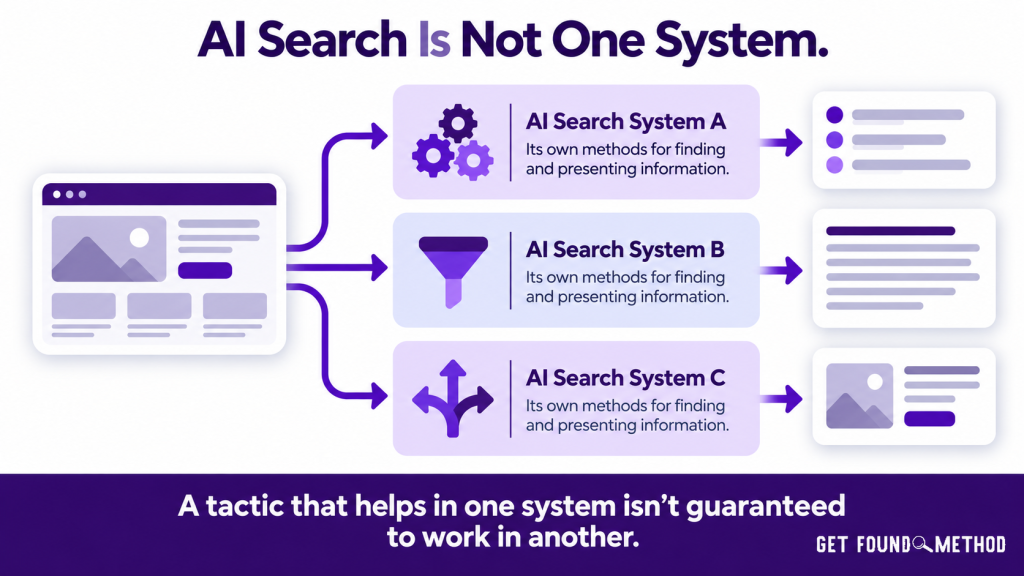
Google’s guidance also has a boundary: AI search is not one system.
Google’s guidance covers Google’s own AI features. Other AI tools have their own ways of finding, evaluating, and presenting information.
OpenAI, for example, states that ChatGPT Search ranks search results using multiple factors intended to surface relevant and reliable information. OpenAI also explicitly says placement is not guaranteed. Its public documentation does not disclose those ranking factors or make the same statement Google makes about the relationship between its AI search experience and established SEO practices.
Google and OpenAI describe their AI search tools differently, and Google has publicly connected its AI features to established SEO practices. That leaves little support for the idea of one AI optimization method that works everywhere. Something that helps a business appear in Google’s AI features may not have the same effect in ChatGPT, and neither company’s published guidance establishes that it will.
Before paying for an AI visibility service or changing your search strategy, it’s worth knowing which platform the advice applies to, what the recommended practice is supposed to accomplish, and what evidence connects the two. Without those answers, it’s easy to end up paying for another marketing activity without knowing what it’s expected to do.
AI-powered search is changing how people discover businesses and information online. The language around that change is still developing, so terms like GEO, AEO, AI SEO, and AI search optimization can make the landscape seem more settled than it is.
Service business owners don’t need to master every new acronym to make sensible decisions about AI search. They need enough understanding to see where AI search fits alongside regular search, and to tell a genuinely new consideration from an old tactic with a new label. As new terms keep appearing, a new name shouldn’t automatically mean a new set of tactics to chase.
Knowing where AI search fits is different from knowing where your business should focus next.
The Get Found Method Local SEO Playbook provides the decision-making framework behind that choice. GFM’s Order of Operations helps you evaluate your business, search priorities, website, keywords, and visibility efforts in the right sequence, so you can weigh new opportunities in context instead of adding disconnected tactics.
Explore the Local SEO Playbook →