
Once a business owner accepts that AI-powered search is changing how customers find businesses, the next question is practical: where do you start?
Much of the advice about SEO for AI search begins with tactics: restructure your content so it’s easier to quote, or sign up for a tool that tracks how often AI answers mention your business. Some of these tactics may fit in your marketing plan, but choosing among them requires knowing what you’re trying to accomplish.
Your website might already give some services plenty of attention, but those aren’t necessarily the services you want more customers for. Before spending money on AI search tools or more optimization, take a look at what your business is actually telling people online. Does it reflect the services you want to grow?

AI-powered search can draw on what’s published about your business, from your own website to other sources online. Different platforms use different sources and may present what they find differently.
Google, for example, connects its AI features to established SEO practices, and its documentation for those features lists keeping Business Profile information up to date as one of the practices that remain worthwhile.
Think about the last time you really looked at your website. Have your services changed since then, or the kinds of customers you take on? It’s common for a business to grow while its website and online profiles keep describing an earlier version of it.
Search platforms don’t know your business priorities. They don’t know which services you’d like to sell more of or which jobs make the most financial sense for you. That’s something you have to decide before you can judge how well your business is represented online.
A service business can offer many services without wanting to grow them all equally. A landscaping company might handle weekly lawn care, seasonal cleanups, and larger design-and-installation projects while seeing installation as its best growth opportunity. That doesn’t mean it stops mowing lawns, and it still needs customers to know lawn care is available. But if every service gets the same emphasis, its online presence may not communicate which services the business is trying to grow.
Revenue alone doesn’t settle the decision, either. A service might bring in strong sales while demanding more labor, equipment, or scheduling flexibility than the owner wants to commit. Another might earn less today but be exactly the kind of job the business is equipped to take on more of.
Weighing those trade-offs takes the owner’s knowledge of operations, customers, and finances. Search data can inform the decision, but it can’t make it for you.
Your website gives you more control over how you present your business than most other places online. You decide which services are explained, what customers learn about each one, and how prominently each appears.
Websites don’t always keep pace with the businesses they represent. A service added a few years in may appear only as one item in a long list, or be described so generally that customers can’t tell whether the business handles the kind of job they need.
Clear service information helps visitors decide quickly whether the business is right for them. It also gives search platforms information they may be able to use when presenting the business in response to related searches.
Your website is only one place people encounter your business. Google Business Profiles, directories, social media pages, and review platforms also shape what customers learn about you.
You don’t have the same control over all of them. Reviews, for example, reflect what customers choose to share, so a business can accurately describe a newer service long before it has many reviews about it.
The information you do control should be accurate across platforms. Your business name and service area should be correct, and the services you describe should agree from one place to another. The wording doesn’t have to be identical.
Google’s Business Profile guidelines require businesses to represent themselves the way they’re known in the real world. They also cover accurate location information and choosing categories that reflect the business. Those rules apply to Google Business Profiles specifically, not to every platform that uses business information. Still, consistent information helps customers recognize the same company wherever they find it, and it reduces conflicting details for platforms that draw on those sources.
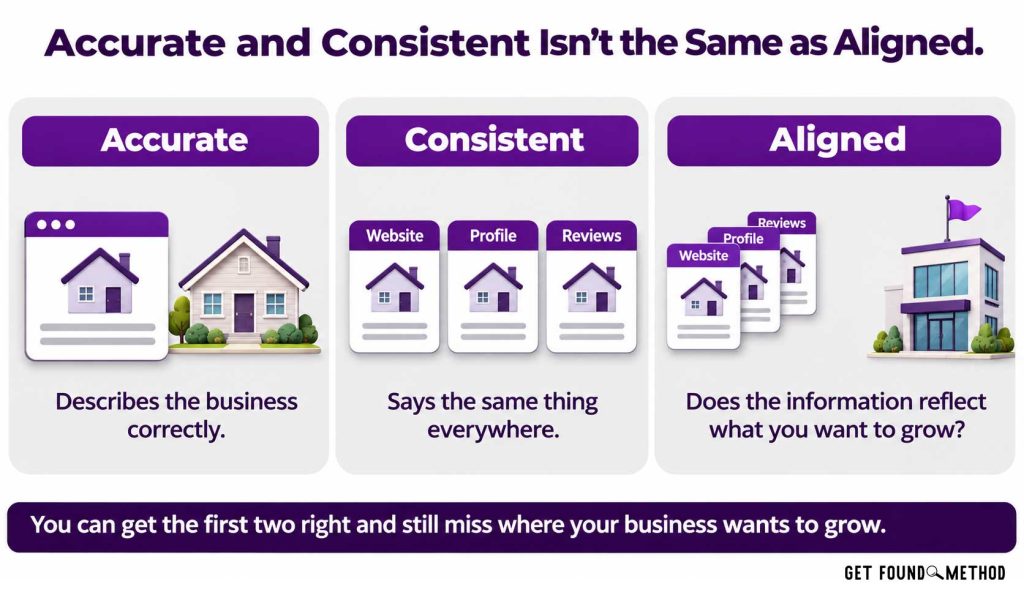
Accurate information describes the business correctly. Consistent information describes it the same way everywhere. Aligned information puts the most emphasis on the services the business is focused on growing.
You can get the first two right and still have an online presence that doesn’t reflect your current business priorities.
Consider a cleaning company that has built a successful residential business. Its website covers house cleaning, apartment deep cleaning, and move-out services. Its Google Business Profile describes the same kinds of jobs, and most of its reviews come from homeowners.
Now the owner wants to grow commercial cleaning, particularly recurring office-cleaning contracts. The company already has the staff and equipment to take on those accounts.
None of the company’s online information is inaccurate. It reflects the residential business the company has built over time, and those customers may remain an important part of its revenue.
A facilities manager looking for an office cleaning provider, though, might visit the website and see a company focused on homes and apartments. Even if the business can handle commercial accounts, the website gives that manager little reason to consider it. An AI-powered search platform using that information could encounter the same mismatch, although how it presents the business would depend on the platform and the sources it uses.
The owner doesn’t need to erase the company’s residential history or pretend it has always specialized in commercial cleaning. The business needs a public presence that accounts for both its established services and the direction it intends to grow. Until that decision shows up online, reformatting content or adding technical markup won’t, on its own, resolve the mismatch.
Once the business knows which services it wants to prioritize and has looked at how those services are represented online, AI search advice becomes much easier to evaluate.
Suppose a tool offers to monitor how often AI-powered search mentions your business. That information may be useful, but you’ll only know how to read the results once you know which services you’re trying to become more visible for.
Or suppose someone recommends restructuring your website content so AI systems can identify specific answers more easily. There may be good reasons to do it. The first questions, though, are which services deserve that attention and whether the content represents them accurately.
In both cases, the business’s priorities determine the tactic’s value. A change that draws attention to a low-priority service is usually worth less than one that improves how the business presents a service it wants to expand.
Get Found Method recommends this order because it connects search decisions to business goals. It draws on established SEO principles and the practical needs of service businesses. Google and OpenAI don’t prescribe it, and it doesn’t describe how AI platforms evaluate or rank businesses.
Getting your business foundation right puts you in a stronger position for AI-powered search. If your business appears in an AI-generated answer, you want what people see to line up with your current business priorities.
AI search gives you another reason to examine how your business is represented online. Accurate information is important, but it should also reflect the services you want to grow and maintain. That’s a decision only you can make, and once you’ve made it, it’s much easier to see what to publish and which improvements are worth paying for.
This article explains why your business priorities should come before AI-specific tactics. Deciding what they are for your own business is the next step.
The Get Found Method Local SEO Playbook helps you make that decision and carry it through your website, profiles, and search choices, using GFM’s Order of Operations to put business goals ahead of tactics.
Explore the Local SEO Playbook →