
If you’ve searched online for the answer, you’ve probably seen articles recommending 10 reviews, 50 reviews, or even hundreds as the magic number your business should reach.
The problem is that none of those numbers can tell you how many Google Reviews your business actually needs.
A plumber in a small town isn’t competing under the same conditions as a personal injury attorney in a large city. Yet many articles treat review goals as though every business is playing the same game.
The truth is much simpler.
There isn’t a universal number of Google Reviews every business needs. The right goal depends on the businesses you’re competing against and the level of trust customers expect before choosing a local service provider.
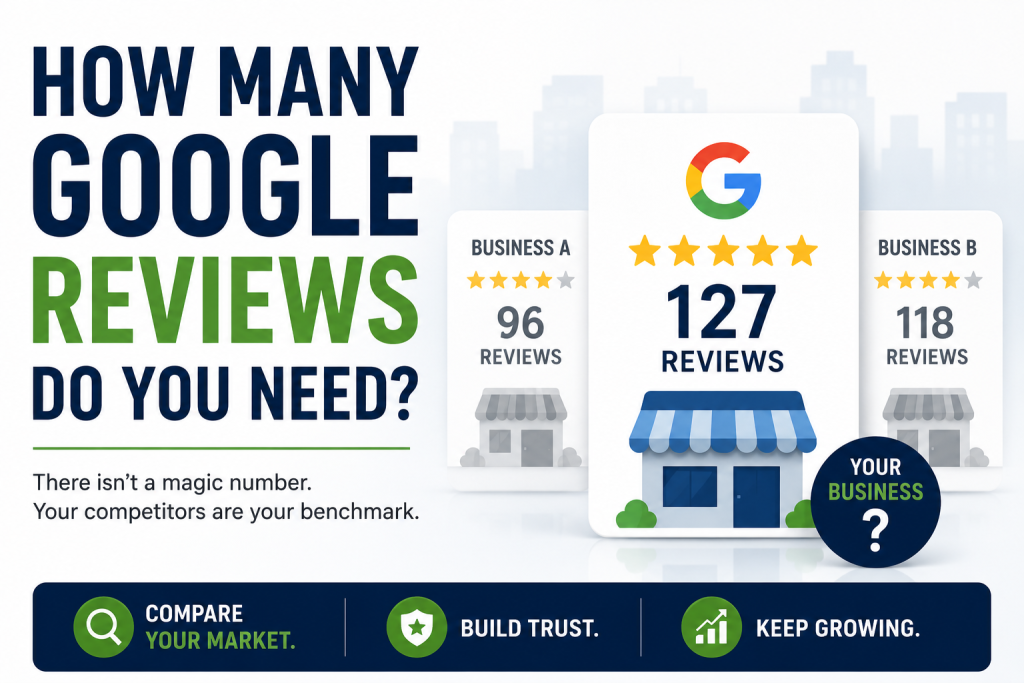
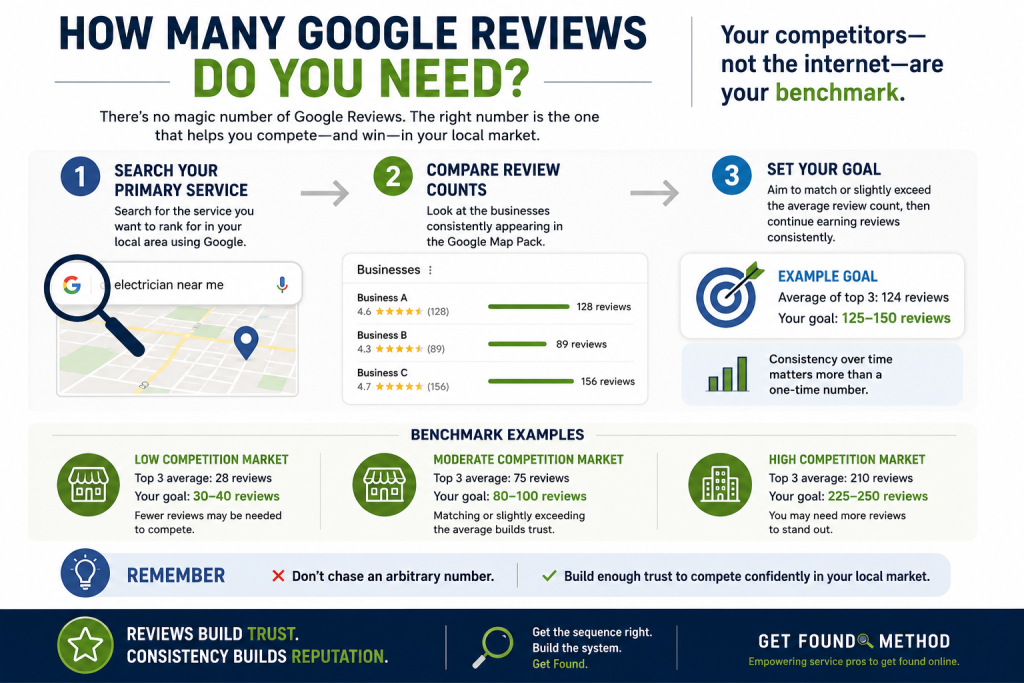
As a practical starting point, your goal should be to match or slightly exceed the average number of reviews held by the businesses that customers are already choosing in your local market.
For example, if the businesses consistently appearing in Google’s local results average around 30 reviews, reaching 30 to 40 quality reviews is a realistic first milestone. Once you’ve established that level of credibility, continue earning reviews consistently rather than chasing an arbitrary total.
If your competitors average 150 reviews, your long-term goal will naturally be different. The important point is that your benchmark should come from your local market—not from a generic article online.
Think of your competitors as your benchmark—not the internet.
That approach gives you a review goal based on reality instead of someone else’s opinion.
Google has never published a minimum number of reviews required to rank well or attract customers. That’s because reviews don’t exist in isolation. Your business is competing against other local businesses, and that’s exactly how customers compare their options.
When someone searches for a service, they’re usually comparing several businesses that appear together in the search results. They’re looking at review counts, star ratings, business information, websites, and other signals before deciding who to contact.
A business with 35 reviews may appear well established in one market, while another business with 200 reviews may still struggle to stand out in a more competitive area.
That’s why copying someone else’s review goal rarely makes sense.
Understanding why there isn’t a magic number is only the first step. The framework below shows how to determine a practical review goal by comparing your business with the competitors customers are already choosing.
Many business owners think about Google Reviews only in terms of SEO.
While reviews can support your local visibility, their greatest value is helping potential customers feel confident choosing your business.
When people compare local businesses, they’re often asking themselves simple questions.
“Can I trust this company?”
“Have other customers had a good experience?”
“Do they seem established?”
Reviews help answer those questions long before someone picks up the phone or submits a contact form.
If you’re wondering how reviews fit into Google’s broader evaluation of local businesses, read our article on Do Google Reviews Help SEO? It explains why reviews are an important trust signal but only one part of a much larger local visibility system.
Once you’ve reached a competitive review count, your goal changes.
Instead of trying to reach the next milestone, focus on earning reviews consistently as you continue serving customers.
A steady stream of authentic reviews tells both Google and potential customers that your business is active and continues to deliver positive experiences.
It also strengthens your reputation over time.
Nearly every business eventually receives a negative review. When you’ve built a strong history of positive customer feedback, one unhappy experience is far less likely to influence how future customers view your business.
That’s another reason consistency matters more than chasing an arbitrary number.
Reviews are an important part of building trust, but they shouldn’t become the only number you watch.
Customers are evaluating your business as a whole. Your Google Business Profile, your website, your services, and the overall experience you present all contribute to whether someone decides to contact you.
That’s why two businesses with similar review counts can produce very different results.
There isn’t a magic number of Google Reviews that guarantees better rankings or more customers.
The better approach is to understand your local market, compare your business to the competitors that customers are already choosing, and build enough reviews to compete with confidence.
The question isn’t whether your business should have 25 reviews or 250.
The question is whether potential customers see enough positive experiences to feel confident choosing you.
That’s why the best review goal isn’t based on generic benchmarks. It’s based on the market you’re competing in today.
If you’re looking to strengthen your Google Business Profile beyond reviews alone, the Google Business Profile Strategy Guide explains how reviews work alongside the other parts of your profile to support long-term visibility on Google.
Related Insights